Ammachi’s Glasses
Priya Kuriyan
This entertaining wordless picturebook was recommended to me by Dr Prachi Kalra, an Indian academic who teaches children’s literature at the University of Delhi. She described it as a ‘cheeky account of a day when everything went wrong because grandmother lost her glasses. The caricatures, the details which reflect a certain culture, are all drawn in bold colours, and most children love the humour.’
There is certainly comedy here on every page. Each spread deserves a long look in order to discover all the drama, hidden jokes and fun details.

The first spread shows six small panels and two-and-a-half cut-outs, while the rest of the story is shown in full-bleed spreads. It shows Ammachi – which means ‘grandmother’ in the Malayalam language – waking up and searching for her glasses. She looks for them on the table and both on and under the bed. When she can’t find them she stumbles towards the dining room, feeling her way forward with her hands.
The panels here are closely sequential and have the feeling of a cartoon strip. Two particular things of note are the bubble showing a visual clue as to what Ammachi has lost (her glasses), and the half cut-out on the right-hand side, which gives Ammachi’s movements momentum while also encouraging the reader to turn the page. Also spot the false teeth in a glass!
Ammachi herself is exaggerated, with an overly round body and face, closed eyes indicating she can’t see anything, and large hoop earrings standing out from either side of her head. Later on we also see her hairy chin. She is clearly a larger-than-life character.

As soon as Ammachi enters the dining room, she trips over the dog, who is chasing his ball. On this spread we are introduced to the other members of the family. As well as the dog, there is also Dad, Mum, the little girl, the cat (laughing at the dog’s discomfort) and, on the windowsill, a crow. Keep an eye on him – he is going to play an important role in the story.
Next Ammachi begins the laundry, watched on by an alarmed Mum and daughter, and accidentally washes the cat along with the clothes. The cat is not best pleased, but worse is to follow, as afterwards Ammachi hangs the cat on the line to dry. This time it is the dog’s turn to get his own back by laughing at the cat.

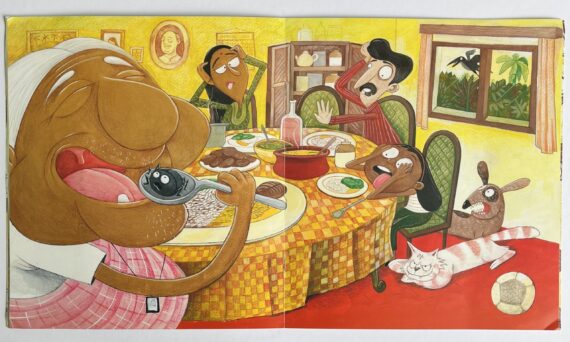
The chaos continues as next Ammachi cooks lunch and accidentally adds a rubber flip-flop into the pan. Then she dresses in a top that is too small for her, with buttons that threaten to burst open at any minute. Finally, at dinner, she nearly eats a spider!
All the family, including the animals, are horrified by the grandmother’s antics. Their faces and body language depict their dismay, with Mum going boss-eyed, Dad putting his hand out to stop Ammachi eating the spider and the little girl covering her eyes. The dog also looks aghast. But it is the cat’s expression that is especially comical, infused with a malevolent pleasure that Ammachi, after treating her so ignominiously, is getting her just deserts.
The cultural details in this spread, and others, are fascinating, particularly the unusual (to Western eyes) fruits and foods and a fearsome-looking scythe hanging on the kitchen wall.
As darkness descends, Ammachi wanders outside for some fresh air and ends up walking up the base of a tree. This time it’s only the animals who see her and indicate their alarm.
Ammachi finds a comfortable spot to sit and falls asleep in the tree. The cat’s expression has now softened. Despite her fury at Ammachi, she is more concerned than angry now, and we are left to conclude it is she who alerts the family to the grandmother’s plight. For soon everyone is arriving at the tree, alongside a firetruck and two strong fight fighters who escort Ammachi down a ladder to safety.

But one fireman does more than rescue Ammachi – he finds her glasses! That naughty crow had hidden them in her nest.

The fire fighter brings the glasses down to Ammachi and the entire family is relieved.
The next day a tired Ammachi recovers by dozing off on a lounger, a book resting in her lap. There is some witty wordplay here because the book’s author is ‘Franz Kaka’, a twist on Franz Kafka. This echoes an earlier verbal joke: the newspaper Dad is reading at breakfast is The Hindooo.
It seems that order is restored. But then we spot that crafty crow, sneaking up to take Ammachi’s glasses. Is the whole story about to repeat itself?

Priya Kuriyan (b.1981) is an Indian comic book writer, illustrator and animation film maker. She has illustrated more than 100 books and collaborated with various different writers. She has also directed episodes of the Indian edition of Sesame Street. In 2019 she was the illustration winner of the Big Little Book Award.
Other books in this wordless picture books series from Tulika are Ammama’s Sari and Flutterfly, both by Niveditha Subramanian.
Once again my thanks go to Dr Prachi Kalra, who also recommended A Visit to the City Market by Manjula Padmanabhan. Published in 1986, it was one of India’s first wordless picturebooks.